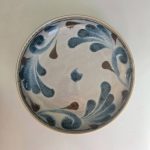


If you’ve looked at Japanese tableware online you’ve run into two words that both translate loosely to “small plate”: mamezara and kozara. They sit side by side in catalogues, they sound as if they mean the same thing, and it’s easy to assume you only need one of them. They are actually two different tools, sized for two different jobs, and once you know the difference a lot of Japanese table settings click into place.
This is a plain-language guide to telling them apart, with the sizes and the jobs, so you can pick the ones that earn their cupboard space.
What the words mean
Mamezara (豆皿) is the “bean plate.” Mame means bean, and a zara is a small dish — so the name tells you what it is: a plate sized for something small, the kind of thing you’d serve a handful of beans on. They run small, roughly 8 to 10 centimetres across, and they’re the workhorses of the Japanese table for the littlest jobs.
Kozara (小皿) is the “small plate.” Ko is the prefix for small, and sara is a plate. Where a mamezara is a condiment dish, a kozara is a proper little serving plate — bigger, anywhere from about 12 to 18 centimetres, and sized for a real portion of food rather than a spoonful of it.
The short version: a mamezara holds the accompaniment, a kozara holds the course.
What a mamezara is actually for
The “bean plate” earns its name at dipping time. It’s the dish for soy sauce or ponzu beside a plate of gyoza, the little bowl of salt next to grilled eggplant, the mound of tsukemono pickles at the edge of a bento, or the dish you rest your chopsticks on mid-meal. In a Japanese home a small number of them get used every single day, in rotation, for whatever needs a tiny landing spot.
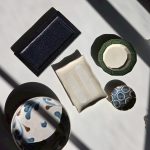
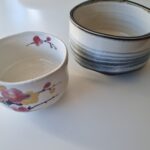
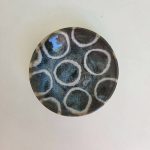
Because they’re small they invite being collected. Buy several and you get variety without it feeling like clutter — this is the category where a thick Okiinawan-style glaze or a hand-painted motif shows up close enough to notice. Our Island Ripple Mamezara is a good example: a deep indigo speckled glaze with pale circles, small enough that holding it in one hand you can really read the texture, at $8.00. The Sakura Bean Bowl | Mamezara, a pink cherry-blossom piece from Mino ware at $7.99, is the other end of the same idea — a mamezara that means to be looked at.
A set of four or six of these is the classic gift, because they stack small and work for everyone.
What a kozara is actually for
A kozara is what a guest gets served on. It’s the plate for a single appetizer, a piece of seasonal fruit, a dessert, or a small side served to someone rather than passed around. It’s big enough to hold a real portion and to present it properly — that small-plate-with-a-job is exactly why you see it in set meals like kaiseki, where each dish arrives on its own small plate.
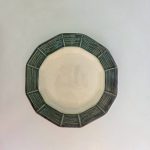
Because a kozara shows up at the table in front of other people it tends to carry more decoration. The Flower Side Plate | Kozara is Hasami ware, its scalloped edge doing the decorative work, at $11.99. The Good Luck 5-Piece Set | Engi-e Kozara is the argument for owning a set rather than a single: five kozara, each with a different lucky motif from Takayama kiln, so a table of guests all get their own pattern, $49.99.
Which do you need?
You need both, but not in equal numbers.
Buy mamezara in multiples. They’re the daily-use dishes — buy four to six and you’ll have a dipping dish, a pickle dish and a chopstick rest all at once. Cheap enough that a set is an easy first step into Japanese tableware.
Buy kozara when you serve people. If you cook for others at all, two or four kozara turn a meal into a set of courses instead of a pile on one plate. They’re also the more gift-appropriate size — a kozara reads as “a plate,” where a mamezara can seem oddly tiny to someone who’s never seen one.
The honest answer is that every Japanese kitchen owns mamezara in quantity and kozara in a matching set, and the two work together: a mamezara of pickles sitting beside a kozara of rice is a complete little meal that still only uses two dishes.
A fork in the road: the mamezara-as-appetizer
On the modern table the line blurs, and that’s worth saying plainly. The deep, bowl-like mamezara are often used for single-serve portions — a spoonful of edamame, three slices of sashimi, a tasting of ice cream. Hold one and it will usually fit that job even though its traditional home is dipping sauce.
So the practical rule is less about the category name and more about depth: a shallow mamezara is for sauces and pickles, a deeper one works as a miniature bowl. Either way, buy the size that matches the food you actually serve rather than the strict dictionary meaning. The dictionary meaning just tells you where to start.
Rounding it out
If you’re new to this, one pair tells the story: a mamezara for your dipping sauce and a kozara for your main. That’s the whole table setting in two plates, and it’s how a lot of people start before they expand into a full set.
For the everyday workhorse, start with mamezara — they’re the plates that get used most and the price makes collecting them painless. For serving anyone you care to, add kozara. Together they’re the small-plate foundation of a Japanese table, and they’ll be the dishes you actually reach for on a normal weeknight.
Worth knowing before you buy: the dishwasher is hard on hand-glazed pieces, so these small ones are best washed by hand — the glaze is the point of them, and it’s what you’re protecting. Buy what you’ll use, wash it by hand, and a small plate earns its place fast.