

Yachimun is the Okinawan word for pottery. It is not a brand, a maker, or a term invented by a marketing department — it is dialect, the way people on Okinawa have said “pottery” for centuries. If you have seen a piece described as yachimun style and wondered whether that meant a region, a technique, or a person, here is the short answer.
A four-hundred-year history, quickly
In 1616 three Korean potters — Ichiroku, Ikkan and Sankan — were brought to Okinawa through Satsuma to teach Korean kiln techniques at the Wakuda kiln in Naha.
In 1682, King Shō Tei consolidated three scattered kilns — Wakuda, Chibana and Takaraguchi — into a single pottery district. That district is Tsuboya, in Naha, and Tsuboya-yaki became the shorthand for Ryukyuan ceramics.
Three centuries later the district ran out of room. Naha grew up around the kilns, and the constant smoke from wood-fired furnaces became impossible to live with. In the late 1970s production shifted north to Yomitan Village, where the Yuntanza Gama climbing kiln was built. Not every potter went quietly: Kinjo Jiro refused to swap the traditional climbing kiln for a gas one and moved to Yomitan to keep firing with wood. Today Yachimun no Sato in Yomitan holds around nineteen studios and four climbing kilns, still burning wood.
The two kinds of yachimun
Unglazed and glazed wares are named separately in Okinawa. Arayachi is rough, unglazed stoneware — the big jars, including the ones awamori is aged in. Jōyachi is glazed, decorated ware: plates, bowls, cups, the things that go on a table. When someone says they collect yachimun, they almost always mean jōyachi.
What makes it recognisable
Four things do most of the work.
The first is weight and roundness. Forms are thick-walled and generous, with a curve that looks hand-drawn rather than drafted. You can usually see the foot, the raised ring on the underside, sitting slightly irregular.
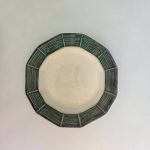
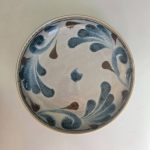
The second is cobalt. The pigment, gosu, gives a blue close to the sea around the islands — deep, a little uneven where the brush moved fast. Designs are painted with confidence: arabesque vines, waves, fish, grasses, bold outlines rather than fine detail.
The third is the glaze itself. It is applied thickly, so it pools in ridges and thins over rims, breaking from glossy to matte in the same piece.
The fourth is the clay body. Underneath the glaze the clay is warm and iron-bearing, showing as earthy brown, sandy cream, or a dark speckled grey.
How it differs from the Japanese pottery you already own
Most Japanese tableware sold in New Zealand comes from mainland traditions — Mino in Gifu, Seto, Karatsu, Hasami. These are the crisp, evenly glazed pieces most people picture when they think of Japanese ceramics, and many are porcelain: thin, light, and bright when you tap them.
Yachimun goes the other way. It is stoneware, so it is heavier in the hand and holds heat longer, which matters when you are eating something soupy out of a wide dish. Where mainland ware often aims at symmetry and an even finish, yachimun keeps the evidence of the hand: a thumbprint in the foot, a glaze run down one side, a rim that is not quite level.
That preference is not accidental: the folk craft movement liked Okinawan pottery in the 1920s and 30s precisely because it was made to be used, not displayed.
Telling hand-thrown from factory cast
Factory-cast ceramics are identical to each other: even thickness, no weight variation, often a faint mould seam down one side, and nothing on the base except a printed mark.
A thrown piece has more to read on the base: firing rings where the potter’s fingers drew the clay up, a foot cut with a tool so the edge is faceted rather than smooth, and slight weight differences between two pieces of the same design.
Then there is kiln variation. Two plates from the same run, glazed by the same hands on the same day, come out different: one bluer, one a little browner, one with the glaze pulled thin across a ridge. This is why “each piece is unique” appears on so many Japanese ceramics listings without exaggeration. It is not a sales line, it is how the process behaves.
Which also means small faults are honest. A pinprick in the glaze, a run over the rim, a thumbprint in the foot — these are the marks of a piece made by a person, and they are part of what you are buying.
Using it at home
The shapes are practical, and worth matching to what you actually cook.
A wide, shallow ōzara — the bowl-plate hybrid — is the right vessel for one-bowl meals, the food that does not fit neatly on a plate: cold somen, a salad that is genuinely dinner, curry with the rice pushed to one side. Because it is shallow, a stew served in the middle keeps its liquid where you can reach it.
A mamezara, literally a “bean plate”, is the small dish that holds what the main dish needs: soy sauce, salt, pickles, a spoonful of grated ginger. Buy two or three before you buy anything else — they are the cheapest way to live with a glaze and see how it behaves in your own kitchen.
Donburi are for rice and noodles, and kobachi for side dishes. A Japanese-style meal at home is usually one bowl of rice, one bowl of soup, and three small dishes — a small-plate habit far more than a big-plate one.
Looking after it
Stoneware is not fragile, but it has one real enemy: thermal shock. Do not move a piece straight from the fridge to a hot oven, and do not run a hot bowl under cold water. Let things come to room temperature in between and you will not crack anything.
Hand washing is the kindest option and keeps the glaze glossy over years of use. If you would rather use a dishwasher, put stoneware on the top rack and accept that decorated surfaces may dull slowly.
Fine lines appearing in the glaze — crazing — are normal on stoneware and are not cracks. The glaze and the clay body expand at different rates, and the glaze takes the difference in hairline cracking. It does not mean the piece is failing. Dry pieces properly before stacking, and put a cloth between plates.
Where to start
Be clear about what you are buying. The yachimun pieces we stock are yachimun style — the thick glaze, the cobalt brushwork, the spirit of the thing — made as everyday tableware rather than by named Okinawan potters. That is a deliberate choice: it means the work is affordable enough to use, which is the point of the tradition.
Start with the Island Ripple Mamezara if you want to test the glaze for eight dollars, or go straight to the Ocean Spray Ōzara if you want the cobalt and the brushwork at full size. Both sit in the Plates category along with the rest of the range.
Use it. That is the whole instruction.